Apodex 1.1: Scaling Agentic Intelligence for Complex Work
A useful research agent must do more than retrieve information and produce a report. It needs to inspect real files, execute analyses, maintain state, recover from failure, and leave behind work that can be checked and reused. Apodex 1.1 calls this working capability: sustained, verifiable progress toward a real objective.
I contributed to the agent harness and its evaluation and release infrastructure. My work connects long-running execution, multi-agent coordination, and artifact verification through Prax / AgentOS and ApodexHarness. The results below describe the complete team-built model and system, rather than an isolated contribution from any one component. The author list on this page is abbreviated; the report contains the full credits.
Two complementary ways to scale agent capability
Environment Scaling expands the file, search, and code environments in which agents can act and receive verifiable feedback. Tasks require the model to work with data and executable tools, rather than rely on text-only answers.
Agentic Coordination Scaling trains task decomposition, delegation, integration of asynchronous results, and replanning. A coordinator can assign independent work to sub-agents, absorb their findings, and organize further verification as the task evolves.
Both depend on a shared runtime. AgentOS maintains task state outside the conversation history, coordinates tool and agent execution, and tracks which files are working material and which are final deliverables. The open-source FrontierAgent project makes ReAct and Agent Team workflows available through a terminal interface and an evaluation harness.
Reported results: ReAct and Agent Team
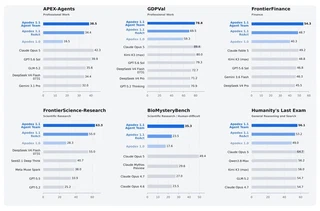
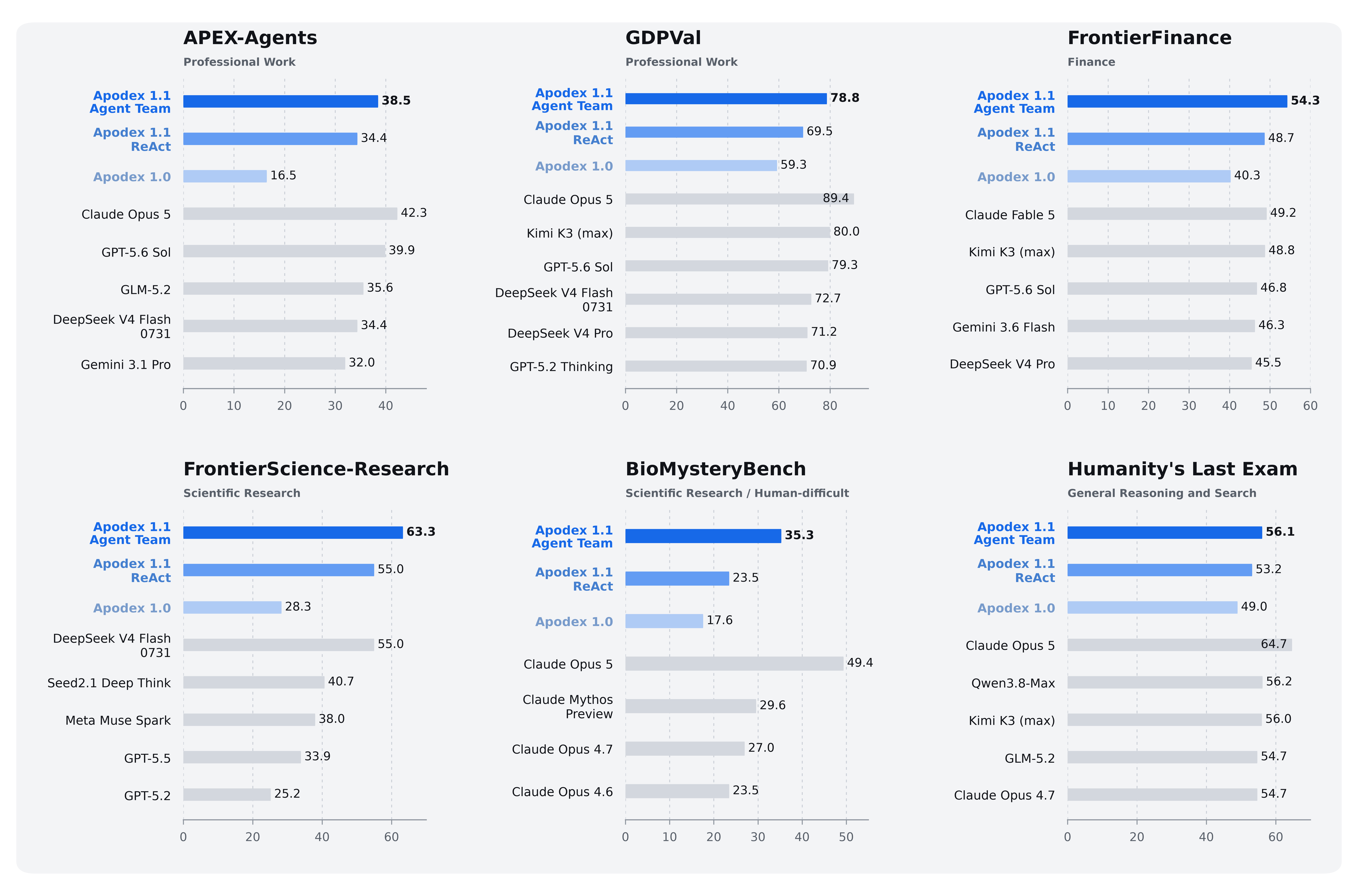
The August 2026 technical report compares a single-agent ReAct setting with Agent Team for the same Apodex 1.1 model. Selected results are reproduced below for readability.
| Evaluation | ReAct | Agent Team | Difference |
|---|---|---|---|
| APEX-Agents | 34.4 | 38.5 | +4.1 |
| GDPVal win rate (%) | 69.5 | 78.8 | +9.3 pp |
| FrontierFinance | 48.7 | 54.3 | +5.6 |
| FrontierScience-Research | 55.0 | 63.3 | +8.3 |
| BioMysteryBench, Human-difficult | 23.5 | 35.3 | +11.8 |
| Humanity’s Last Exam | 53.2 | 56.1 | +2.9 |
Differences are in each benchmark’s reported score units; the GDPVal change is in percentage points. Agent Team uses additional coordinated computation, so these comparisons are not matched-compute estimates of the effect of coordination alone. They are a dated snapshot of the report’s evaluation, not claims about a current leaderboard.
From runtime behavior to usable research tools
For researchers, the runtime supports keeping a task moving through changing evidence and user feedback: intermediate files survive, the plan can be revised, and results from parallel branches can be integrated. The official release article explains how this appears in the workbench through live intervention, visible progress, and review of important claims.
The report also introduces a 35B-parameter Mini model as a locally deployable route to these workflows. This is separate from the full-model results above.
Sources: Technical report v1, 24 August 2026, Sections 3–4 and Tables 3–5; official release article; FrontierAgent source.