FrontierAgent
I initiated and lead FrontierAgent, an open-source agent runtime and research workbench for long-running research and file-based tasks. It combines a terminal interface, sandbox tools, and evaluation workflows for single-agent ReAct and Agent Team execution, and shares reusable infrastructure with ApodexHarness through AgentCore.
Demo
A 1-minute 48-second walkthrough of Agent Team in FrontierAgent’s terminal interface.
The problem: keeping a long task coherent
A research task may involve several evidence sources, analysis scripts, intermediate files, and parallel investigations. Simply adding more agents does not settle who owns the plan, when work is complete, or which files constitute the final result. FrontierAgent makes those responsibilities explicit in the runtime.
Its public interface offers two workflows: ReAct for a stateful single-agent loop, and Agent Team for a coordinator that delegates independent assignments and integrates reports. The same workflow engine also supports benchmark execution, connecting interactive use with repeatable evaluation.
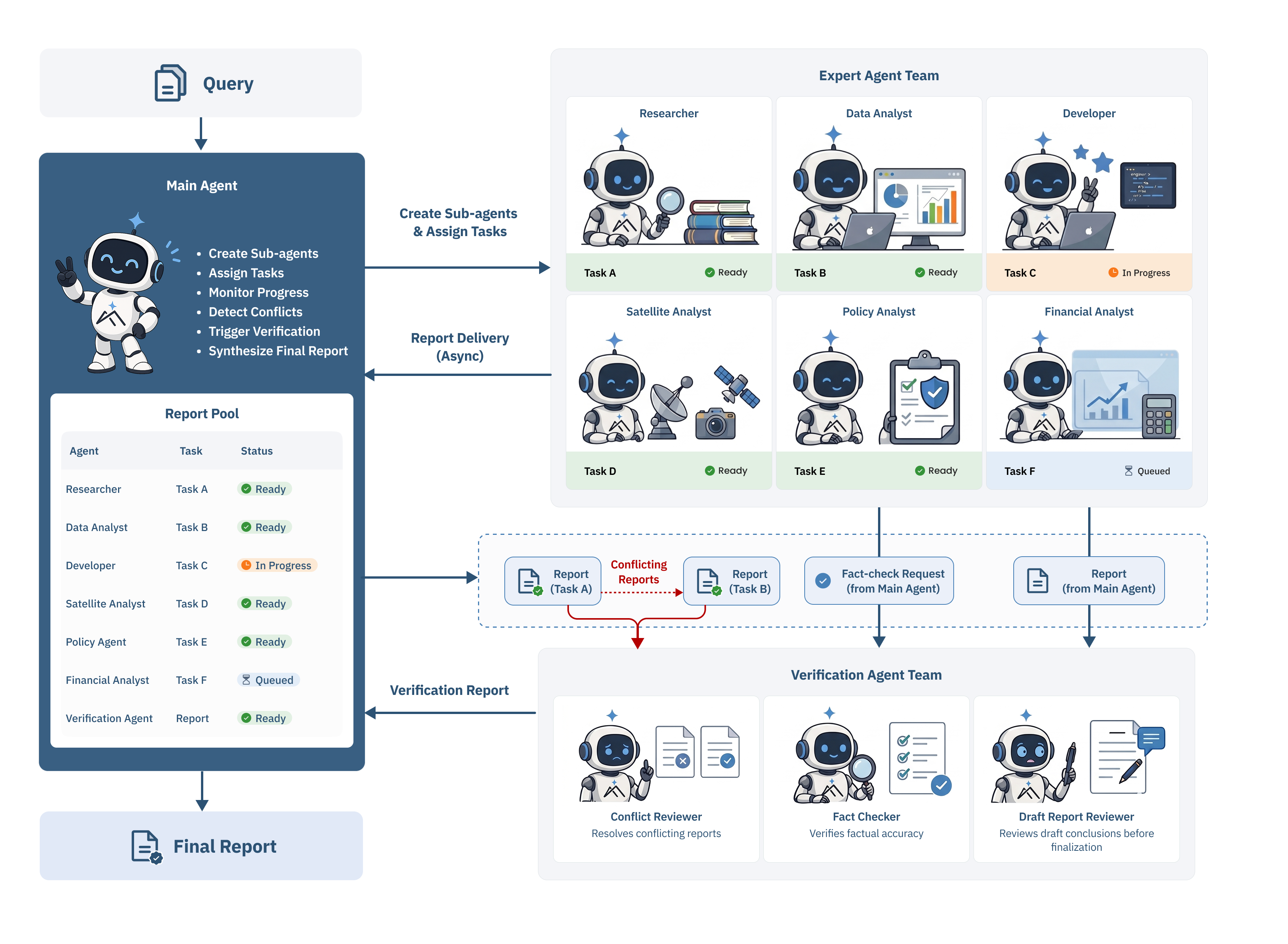
Coordination, state, and delivery
The architecture below separates three responsibilities that become tightly coupled during a long run:
- Coordination: the main agent maintains an external task board and uses an Agent Bus to dispatch work and collect reports. Execution status and the coordinator’s judgment that a task is resolved are distinct pieces of state.
- Execution: sub-agents produce candidate artifacts in working directories. The isolation backend determines whether those directories are private worktrees or a shared mount. Read-only inputs remain separate from mutable working files.
- Delivery: a single-publisher lease and an explicit output manifest govern final publication. Reconciliation against the initial output state prevents stale or empty files from being mistaken for newly completed deliverables. Shared scratch space remains outside the collected final output.
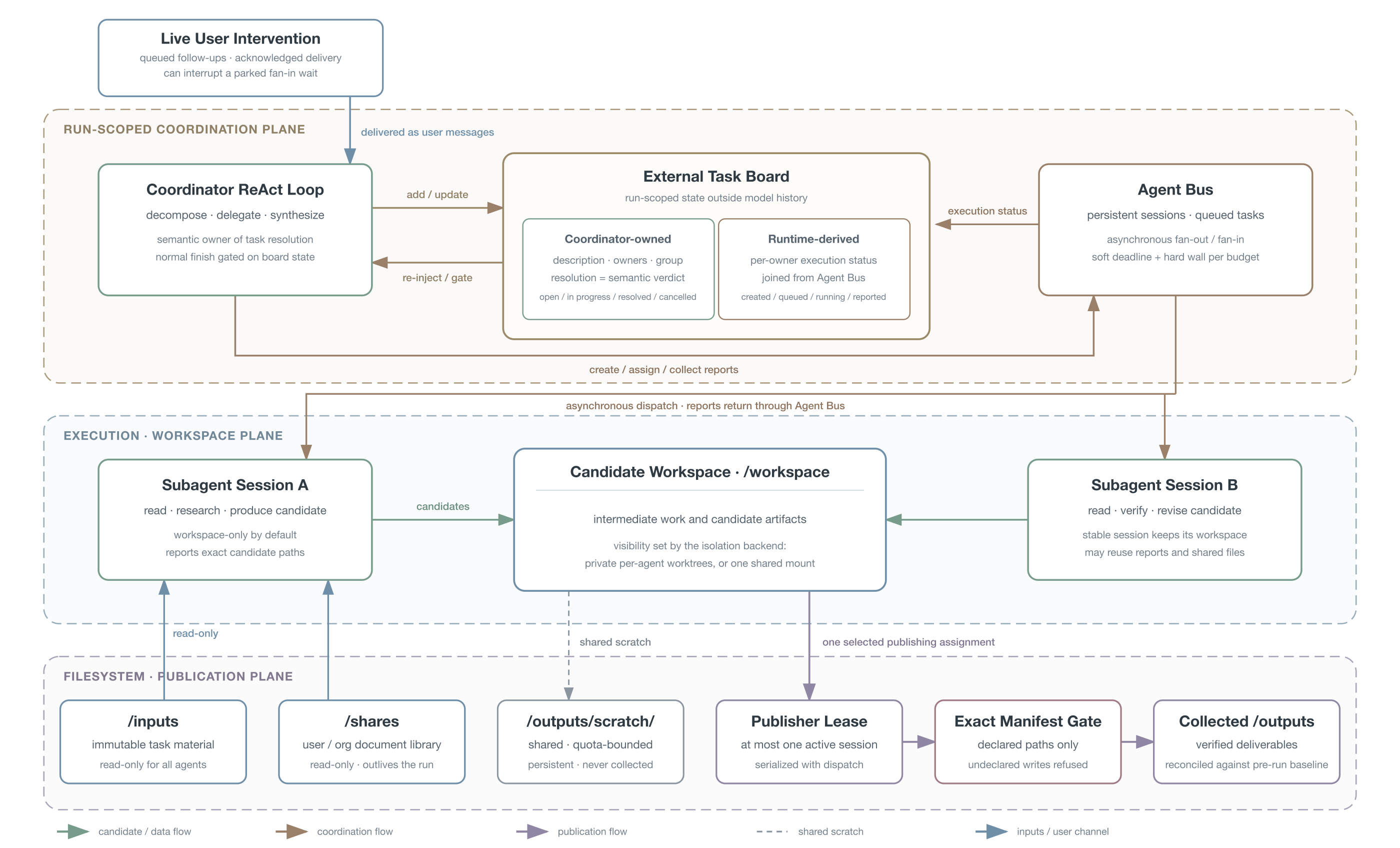
These mechanisms address state loss, ambiguous ownership, concurrent output writes, and premature completion claims. They do not by themselves establish that a scientific method or conclusion is correct; task-specific verification remains necessary. The runtime contract is also described in the Apodex 1.1 report, Section 3.3 and Table 2.
An inspectable workbench and evaluation path
The terminal product exposes the task board, tool activity, artifacts, and local traces. Checkpoints support resuming a session, and follow-up instructions can steer an active run. The evaluation runner supports artifact collection and rerunning failures, making it possible to investigate where a task broke down rather than only record its final score.
The repository also contains FrontierChallenge, which evaluates complete scientific deliverables. See the benchmark paper for its task design and reported completion gaps, and Apodex 1.1 for model-and-system results using ReAct and Agent Team. Those benchmark gains reflect the complete evaluated configurations, not a standalone runtime speedup claim.
Explore: Source code and documentation · FrontierChallenge benchmark source.

About Me
I am an AI Research Scientist on the post-training team at Apodex and one of the founding engineers of Apodex Harness and FrontierAgent. I work on reliable agent systems for long-running tasks: multi-agent orchestration, memory and context management, tool use, and verifiable evaluation. Previously, I led AI development at Watt, a Shanda-incubated startup. I also teach postgraduate deep learning at Nanyang Technological University. My earlier research focused on robot perception and visual SLAM.